
Technology, Innovation, Stewardship and the Future of Hawaiʻi Island
Yishan Wong:
From Silicon Valley to Native Forest Restoration on Hawaiʻi Island
The former Reddit CEO chose Hawaiʻi Island as home. His next undertaking brought engineering, native-plant conservation, and forest restoration together, with ambitions extending far beyond the island.
 By Carol Porter, Realtor® · October 10, 2026
Part of: Technology, Innovation, Stewardship and the Future of Hawaiʻi Island
There is a question running through this series: what happens when someone who has spent a career building technology chooses Hawaiʻi Island as home?
For Henk Rogers , the answer included experiments with renewable energy, water, batteries, hydrogen, and the infrastructure needed to sustain life in remote places. For Earl Bakken , it encompassed healthcare, community, education, and learning the history of the place where he settled.
Yishan Wong’s story takes another direction:
restoring native forests and building
the systems that make restoration possible at scale.
Before coming to Hawaiʻi, Wong worked at PayPal, served as a director of engineering at Facebook, and was Reddit’s CEO from 2012 to 2014.

Today he is founder and CEO of Terraformation, a company whose work began on Hawaiʻi Island and now reaches restoration projects in Colombia, Ghana, and Cameroon. Terraformation describes itself as mission-first, combining nonprofit work that builds local capacity and shares tools with commercial projects designed to attract long-term investment.
What interests me most is the transition between those two chapters, and the role this island played in it.
Choosing Hawaiʻi Island
According to a 2023 Hawaii Business profile, Wong bought a 45-acre property along ʻAkoni Pule Highway in North Kohala with retirement in mind. He wanted to create a small community for friends and family. While living in Waimea, however, he noticed unusually warm nighttime temperatures and began thinking about climate change and ways to remove carbon from the atmosphere.
The accounts of his move and the beginnings of Terraformation do not line up perfectly. A 2021 Forbes report places his family’s move to Hawaiʻi in 2019 and describes his concern about the climate trajectory as beginning in 2017. Hawaii Business gives 2017 as the company’s founding year, a 2025 Trellis report says 2019, and Terraformation’s own history says 2020. Early coverage appears to treat the initial research, the first pilot planting, and the formal company as one continuous beginning.
The broader progression is clear enough. Wong chose Hawaiʻi Island as a place to live, began investigating a problem that concerned him, and eventually made that problem the focus of a company.
His concern prompted an engineer’s question: what could be done at a scale large enough to matter?
His search led him to trees.
A difficult piece of land in North Kohala
Terraformation’s first Hawaiʻi restoration site, Pacific Flight at Kaupalaoa, occupies 45 acres in the leeward rain shadow of the Kohala Mountains.
The company describes a landscape that once supported native dry forest, including ʻiliahi (sandalwood), and had been severely degraded by centuries of logging and cattle grazing. Restoring it meant working with limited water, depleted soils, high winds, and a shortage of native seeds.
Those are practical problems anyone who has worked with land on the dry side of Hawaiʻi Island can appreciate. A planting plan has to account for where the water will come from, which plants belong in the environment, and how they will survive after they leave the nursery.
Terraformation’s own history notes that its leaders made privately owned land available for some of its earliest restoration experiments, and that those sites are now among its most advanced research sites. Wong’s North Kohala property became a place to work through these questions.
The numbers have grown. In 2023, Hawaii Business reported about 7,200 trees and plants in the ground, mostly acacia. Terraformation’s current account reports more than 9,000 plants planted at Kaupalaoa, with restoration involving 22 drought-tolerant native species that include aʻaliʻi, wiliwili, and koaiʻa. Some plantings are beginning to produce seeds that the team can collect. That is an important milestone, because a restoration site can eventually help supply the material for further work.
The work remains ongoing. A planting total does not tell us how many plants have survived long-term, how the ecological relationships are developing, or when the site might function without continued irrigation and care. Those are longer-term questions.
Water, and fire
On Hawaiʻi Island’s dry side, water comes first. At Kaupalaoa, Terraformation installed an off-grid, solar-powered desalination system to provide irrigation water.
The engineering logic is appealing. Sunlight is plentiful in this part of the island, and water is generally simpler to store than electricity. Producing irrigation water directly from solar power, rather than building a large battery system to run pumps around the clock, matches the design to what the site actually needs. The immediate requirement is water for plants. Electricity is one step in producing it.
There is a clear connection here to both Rogers and Bakken. Their Hawaiʻi properties also required close attention to energy and water. Remote locations make these questions difficult to ignore, and sometimes the constraints lead to a different design.
Fire is the other constant on dry-side landscapes. Terraformation reports 17 solar-powered sensors at Kaupalaoa that track fire markers and alert the team for a fast response. It is a modest detail, but it reflects an understanding that a young dry forest has to survive the grass-fire conditions around it.
The people who already knew the plants
Wong’s engineering background is only part of this story.
An important early collaborator was Jill Wagner, a forester and restoration specialist who moved to Hawaiʻi in 1994, began as a volunteer at the Amy Greenwell Ethnobotanical Garden, and later earned an ethnobotany degree at the University of Hawaiʻi. Her restoration work has included projects with the National Park Service, the Department of Hawaiian Home Lands, The Nature Conservancy, Kamehameha Schools, and private landowners. In 2022, when Terraformation announced its seed-bank partnership with Botanic Gardens Conservation International, she was identified as the company’s Chief Forestry Officer.
Her knowledge long preceded Terraformation. Wagner founded the Hawaiʻi Island Seed Bank in 2008 with a grant from the Hawaii Wildfire Organization. Her aim was to save the common species that form the foundation of an ecosystem, so it can be rebuilt after a fire, rather than only the rarest ones. It remains the only public seed bank on the island.
A 2021 Hawaiʻi Conservation Conference abstract by Wagner and seed-conservation specialist Marian Chau described the work at Pacific Flight and a partnership with the Hawaiʻi Island Seed Bank. Terraformation built a solar-powered seed laboratory in a shipping container, a design it would go on to adapt for partners elsewhere.
Wagner also insists on provenance: seeds should come from mother trees appropriate to the elevation and habitat where the seedlings will be planted. That is exactly the kind of place-specific knowledge a software engineer would not arrive with.
Growing a company and restoring a Hawaiian forest require different kinds of expertise. The work brings those skills together.
It also illustrates something I value in the stories of people who move here: the willingness to recognize how much knowledge already exists in the community.
Before there is a forest, there must be seeds
Seed banking is less visually dramatic than a hillside of growing trees, but it is essential to the work.
Seeds must be collected, documented, processed, and stored under conditions that preserve their viability. A restoration project also needs an appropriate mix of species and a dependable supply of planting material. Terraformation developed modular, containerized seed banks to help address those constraints. Its own history describes seed scarcity as the fundamental constraint it met early on.
On January 28, 2022, in an announcement datelined Waimea, Botanic Gardens Conservation International and Terraformation launched a partnership to equip botanic gardens with shippable seed banks housed in recycled shipping containers, with software to track collections and organize species. The effort targeted regions with low seed capacity. BGCI’s State of the World’s Trees report found that 30% of tree species are threatened with extinction and that only 21% of threatened species are held in at least one botanic garden or seed bank collection.
Terraformation now reports that it has deployed 19 seed banks, storing 145 million native seeds, and trained local teams to build their own seed supply. This is one way work developed in Hawaiʻi becomes useful elsewhere: identify a recurring obstacle, develop a practical response, and make it available to other people working on the same problem.
From Kona to other forests
Terraformation’s Hawaiʻi work now extends well beyond Kaupalaoa.
Its headquarters, the Ridge to Reef Restoration Center at HOST Park in Kona, includes seed banking, a dry-forest nursery, and space for community learning. Arizona State University’s Center for Global Discovery and Conservation Science, led by Dr. Greg Asner, is co-located there and is building a coral nursery. The partnership lets Terraformation take what it calls a ridge-to-reef, or ahupuaʻa, approach to restoration, bringing land and ocean conservation together in one location.
In North Kohala, Terraformation leads the first phase of restoration at ʻIole, a 2,400-acre nonprofit living laboratory spanning three ahupuaʻa. The land spent more than a century in sugarcane and macadamia cultivation. The first phase covers a 209-acre parcel and combines native forest restoration, ʻulu and tropical fruit orchards, and silvopasture, with Hawaiʻi Community Foundation, the University of Hawaiʻi, and Arizona State University as partners. Kohala students, researchers, and community members take part in the work.
Terraformation has also been expanding to other islands. In late 2024, it received a $200,000 National Fish and Wildlife Foundation grant to establish a native seed bank and collection program on Lānaʻi, working with Pūlama Lānaʻi inside the Kuahiwi a Kai watershed program, which aims to conserve and restore some 20,000 acres.
Internationally, the company has taken on restoration projects in Colombia, Ghana, and Cameroon, where it is partnering with Iroko Analytics on a Congo Basin project of 14,000 hectares. Two of these projects have received independent A pre-issuance ratings from the carbon-ratings firm Sylvera. In 2022, Terraformation interviewed 230 forestry organizations in 63 countries about what limits their growth, and found funding, seeds and seedlings, and training at the top of the list. Its Seed to Forest Accelerator, modeled on startup accelerators, drew applications from more than 900 organizations. Terraformation reports more than 3,000 training hours delivered to partners, and 5.4 million native trees planted across four countries.
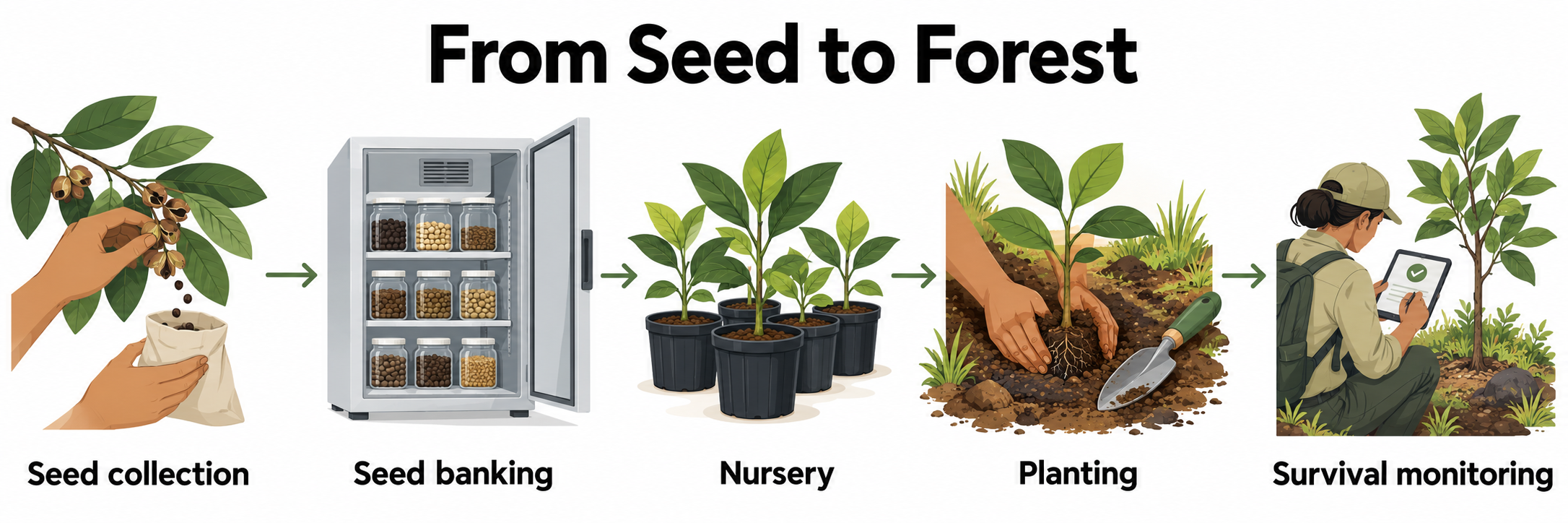
The company’s free, open-source forestry software, Terraware, helps teams manage the process from seed collection through nursery work, planting, and survival monitoring. As of December 2025, Terraformation reported that more than 1,140 organizations in 104 countries use it, with nearly 1.2 billion seeds, 15.6 million seedlings, and 4.7 million plantings recorded. Those records reflect work entered by participating organizations; they are not a count of seeds collected or trees planted by Terraformation alone.
Software cannot grow a forest. It can help people keep track of the information needed to understand what is working and where they need to change their approach.
Ambition and evidence
Wong’s ambitions are large. Terraformation has spoken of restoring 3 billion acres worldwide. The results deserve careful description.
Restoring native forests can contribute to carbon removal, biodiversity, and healthier ecosystems. But forest restoration cannot substitute for reducing emissions. The Intergovernmental Panel on Climate Change explicitly recognizes the importance of land-based climate action while warning that it cannot compensate for delayed emissions reductions in other sectors.
There is also a difference between planting trees and establishing a forest. Survival, ecological function, long-term care, and lasting carbon storage take time to assess. Terraformation appears to recognize this: in December 2025 it launched a funder portal in Terraware that reports survival rates, seeds collected, and hectares restored, rather than planting counts alone.
I think the story is stronger when those distinctions remain visible. There is already meaningful work to describe: native plants growing at Kaupalaoa, seed-banking capacity, local partnerships, and tools other restoration teams can use. The larger goals remain goals.
A place to live, and a place to contribute
What connects Wong to Rogers and Bakken is the way their interests developed after they chose Hawaiʻi Island.
Each brought technical experience. Each encountered a new set of questions involving the place where he lived. Their work then depended on relationships with people whose knowledge and skills complemented their own.
For me, that connects to the way I think about property.
A parcel comes with rainfall, soil, wind, access, water, history, and an existing ecological setting. At ʻIole, a century of sugarcane and macadamia shapes what can be planted now. At Kaupalaoa, centuries of logging and grazing did the same. Understanding those conditions is part of understanding what ownership means and what might be possible there.
Wong bought land in North Kohala with plans for family life. It became a place to investigate how a degraded landscape could support native forest again, and how the lessons might help others. One of Terraformation’s stated values is “We Are Ancestors,” and it is a fitting phrase for anyone who holds land here.
That is why he belongs in this series. His Hawaiʻi Island story is still unfolding, but there is already substance in what followed his decision to make this place home.
Sources and further reading
- Terraformation: Our Story
- Pacific Flight at Kaupalaoa
- Hawaii Business: This Big Island Startup Turns Degraded Land into Thriving Ecosystems
- Yishan Wong’s TEDx talk: Forests—Earth’s Original Solution to Climate Change
- Fortune: Yishan Wong on why he left Big Tech (2024)
- Trellis: Terraformation names Jad Daley president
- Hawaii Reporter: Q&A with Hawaiʻi Island Seed Bank Founder Jill Wagner
- Botanic Gardens Conservation International: Terraformation Partnership
- Maui Now: Terraformation awarded $200,000 grant for Lānaʻi seed bank
- Terraformation Hawaiʻi
- Ridge to Reef Restoration Center
- ʻIole at ʻĀinakea
- Terraware: Funder Portal and Reported Platform Totals
- IPCC: Agriculture, Forestry, and Other Land Uses
Related reading
- Henk Rogers: From Tetris to Energy Independence to the Moon
- Earl Bakken: From the Pacemaker to Hawaiʻi Island
With aloha,
Carol Porter
REALTOR® · RS-87584 · HI · Better Homes and Gardens Real Estate Island Lifestyle
Next step
Questions about your own search?
Every situation is different, and the details change the answer. Tell me what you’re considering and I’ll give you an honest read.