
Caring for Your Home
Roofing Materials for Hawaiʻi Homes: A Practical Island Guide
 By Carol Porter, Realtor® · October 5, 2026
A roof on Hawaiʻi Island may face salt spray, persistent rain, strong winds, intense sunshine, or a combination of these conditions. An oceanfront home, a wet windward property, and a drier inland home can have very different roofing needs. Inland does not necessarily mean sheltered from wind.
There is no single roofing material that is best for every Hawaiʻi home. The soundest choice considers the complete roof system: the covering, attachments, underlayment, flashing, supporting structure, and installation. Budget, solar plans, maintenance, and rainwater catchment also belong in the decision.
Start With the Property, Not the Product
Before comparing materials, consider what the roof must handle.
- Salt exposure: Distance from the ocean matters, but so do breaking surf, prevailing winds, and direct salt spray. Read the manufacturer’s coastal restrictions rather than relying on a universal distance rule.
- Wind exposure: Roof height, shape, terrain, and attachment details affect performance. The proposed system must meet the requirements for the particular site.
- Rain and moisture: Roof slope, drainage, flashing, and moisture management deserve particular attention in wetter locations.
- Sun and heat: Color and tested reflective properties affect heat gain. Metal, tile, and shingles all include products with different thermal performance.
- Solar: Consider mounting compatibility and whether roof repairs or replacement may require removing and reinstalling panels.
- Rainwater catchment: If the roof collects household water, roofing and coating suitability become part of the water-quality decision.
What Local Windstorms Reveal
I have seen concrete roof tiles lost from high-end resort homes during windstorms. I also heard of substantial shingle losses in Waikoloa Village during a recent storm, including displaced shingles breaking neighboring windows. I did not hear of comparable metal-roof damage, although that does not establish that none occurred.
These observations are a reason to take wind performance seriously, even on expensive homes. They are not a controlled comparison of materials, but they illustrate why appearance and price alone cannot establish a roof’s resilience.
Detached roofing can become windborne debris. Tile can break or become dislodged, and metal panels can lift when their attachments or other details are inadequate. A well-designed roof requires attention to the entire assembly, including vulnerable edges, corners, and ridges. The federal Building America guidance discusses these concerns for both metal roofs and tile roofs.
Ask a prospective roofer what they observed in local storms, what failed, and how their proposed system addresses those weaknesses. A product’s advertised wind warranty is not a substitute for demonstrating that the installed roof meets the building’s required wind pressures.
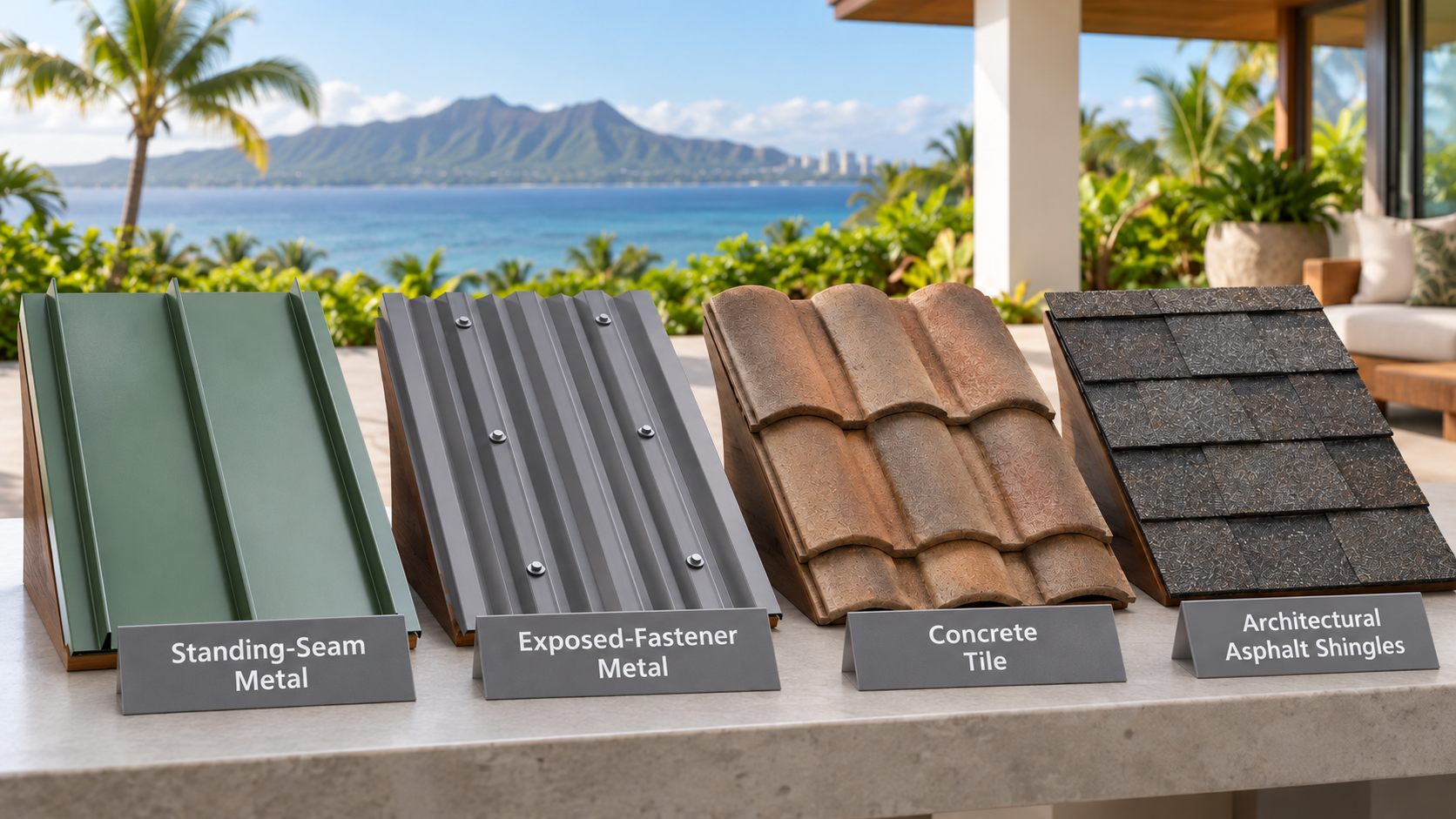
Standing-Seam Metal Roofing
A strong candidate for solar and long-term ownership
Standing-seam roofs have raised seams and concealed attachments. They deserve serious consideration where concealed fasteners and solar compatibility are priorities. Their performance still depends on the particular panel system, attachments, roof edges, and installation.
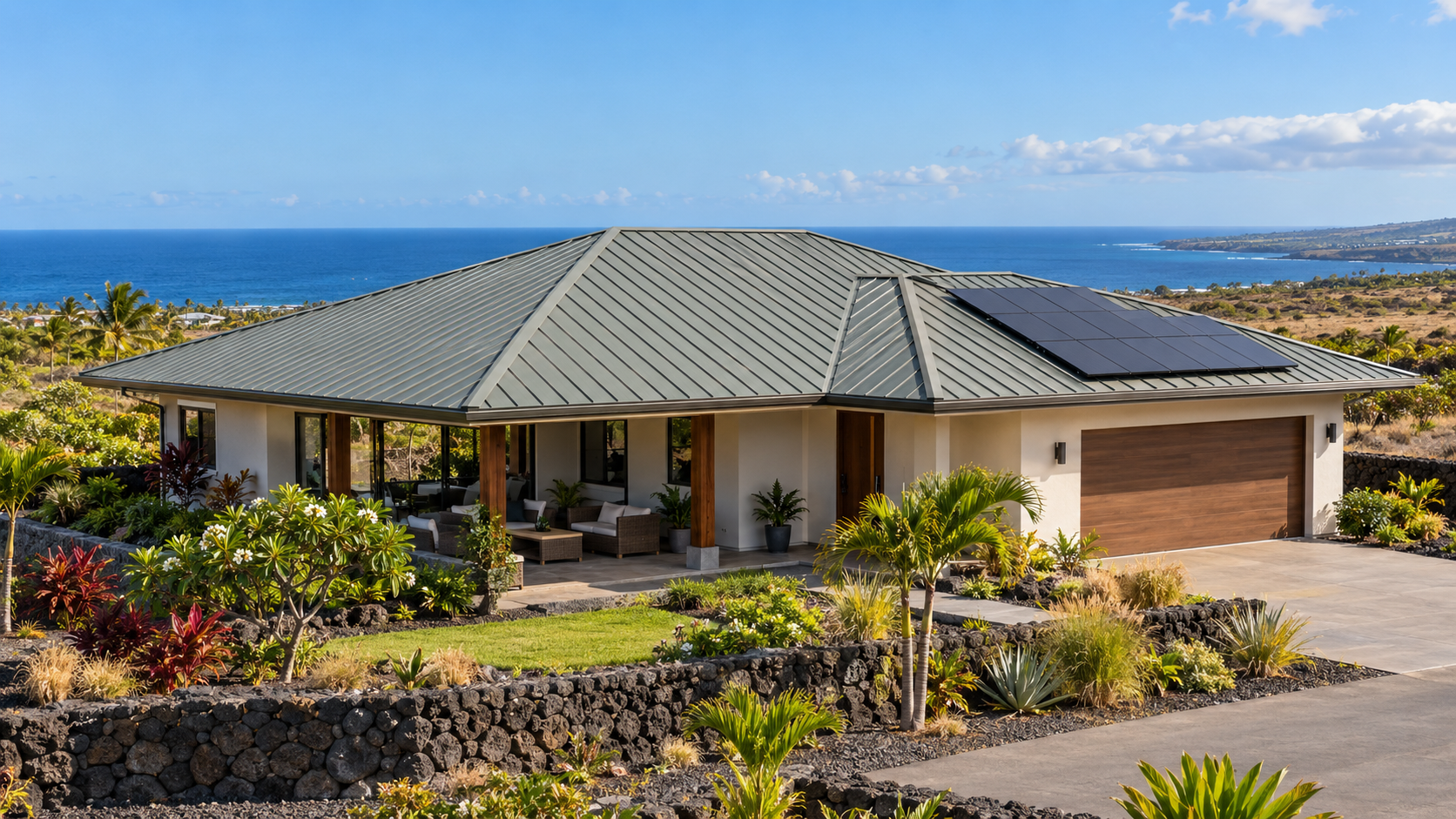
For coastal properties, aluminum is worth evaluating because it does not develop the iron rust associated with steel. It is not immune to corrosion. Trapped moisture, incompatible metals, and unsuitable accessories can create problems. Coated steel may also be appropriate, depending on the exact product, exposure, and warranty.
Read the actual warranty before selecting a material. Coverage for a paint finish, metal perforation, and leaks are different promises. A premium finish does not automatically establish that a steel roof is suitable or warrantied for an oceanfront site. Manufacturer offerings and exclusions vary; for example, McElroy publishes separate warranty documents for finishes and substrates, including Hawaiʻi-specific finish coverage.
Advantages:
Concealed attachments, relatively low weight compared with tile, reflective finish options, and the ability to use nonpenetrating solar clamps on compatible seams.
Trade-offs:
Installation requires experience with the specific system. Coastal accessories and metal compatibility require careful selection. Rain noise depends on the roof assembly, insulation, and ceiling construction. Compare the complete installed price with other systems rather than assuming a fixed premium.
For solar, the clamp must match the seam profile and material, and the attachments must accommodate the required loads. Not every clamp fits every standing-seam roof; S-5's technical guidance illustrates why tested compatibility matters.
Exposed-Fastener Metal Roofing
A useful alternative with different maintenance needs
Exposed-fastener panels are secured through the roofing with gasketed screws. They belong in the comparison when assessing an existing metal roof or obtaining alternatives to standing seam.
The exposed screws and sealing washers are part of the weather protection. Their condition, installation, and compatibility with the panels matter. Inspecting the panels alone is not enough: attachments, flashing, penetrations, and drainage also need attention.
Ask the contractor to explain the expected inspection schedule, suitability for salt exposure, and how future fastener or washer repairs would be handled. Compare total cost and maintenance expectations over your anticipated ownership period.
Concrete or Clay Tile
Durable coverings, with important underlying components
Concrete and clay tile offer an appearance that suits many homes. Their weight and attachment requirements need careful evaluation, particularly when replacing a lighter roof covering. The existing structure must be able to support the proposed system.
The important distinction is between the life of the tiles and the life of the complete roof. Tiles may remain usable while underlayment, flashing, or other components need work. Repairs beneath otherwise sound tiles may involve removing and reinstalling them.
Tile itself does not rust, but metal flashings and attachments can corrode. Tiles can also break from foot traffic or impact, and their wind resistance depends on the approved attachment system. High-end construction does not eliminate these vulnerabilities.
Advantages:
A distinctive appearance, a choice of profiles and colors, and the potential to replace individual damaged tiles.
Trade-offs:
Weight, breakage, access for repairs, solar mounting details, and the eventual condition of underlayment and metal accessories. Tile should not be described as maintenance-free or as automatically hurricane-resistant.
Architectural Asphalt Shingles
A practical choice when initial cost matters
Architectural shingles remain a legitimate option to include in roofing bids. Their suitability depends on the specific product, exposure, approved installation, and maintenance expectations.
Shingles do not rust. On a coastal shingle roof, corrosion protection still matters for flashing, fasteners, and other metal accessories. It would therefore be misleading to rank asphalt itself as having poor corrosion resistance.
Follow the selected manufacturer’s instructions rather than a generic nail-count rule. Wind warranties have conditions and are distinct from an engineering assessment of the roof assembly. GAF’s shingle warranty, for example, conditions coverage on the required installation.
Advantages:
A broad choice of colors and styles, reflective product options, and an alternative worth evaluating where initial expenditure is a priority.
Trade-offs:
Carefully flashed solar penetrations, the possibility of future roof work beneath solar panels, and ongoing attention to shingle condition. Algae-resistant products do not eliminate inspections or appropriate maintenance.
For an existing roof, an assessment of its condition and installation history is more useful than assuming a service life from a warranty label.
Corrugated Polycarbonate Roofing
Corrugated polycarbonate is another material buyers may encounter. I recently sold a tiny home in Ocean View with this type of roof. I advised the buyers to budget for its eventual replacement, but the roof also offers an unusual pleasure: a view of the stars from their loft.
Product quality matters. UV-protected polycarbonate differs from unprotected plastic, and polycarbonate should not be confused with PVC or fiberglass panels. Manufacturer guidance identifies UV protection as important in limiting yellowing and brittleness.
When these panels cover a dwelling, identify the exact product and installation date, examine their condition, and have a qualified professional verify the installation and suitability for that use. Do not assume that a panel marketed for a patio or greenhouse is automatically appropriate as a home’s primary roof. Replacement planning should reflect the actual product and condition rather than a generic lifespan estimate.
A Practical Comparison
| Roof covering | Main consideration | Coastal concern | Solar consideration |
|---|---|---|---|
| Standing-seam metal | Concealed attachments; system-specific installation | Verify metal, finish, accessories, and warranty | Compatible seams may accept nonpenetrating clamps |
| Exposed-fastener metal | Screws and washers require inspection | Verify panel and fastener suitability | Mounts and sealing details depend on the system |
| Concrete or clay tile | Weight, breakage, and underlying components | Metal flashing and attachments still matter | Attachment and flashing require careful detailing |
| Architectural shingles | Product, installation, and current condition | Protect metal accessories from corrosion | Evaluate roof life and flashed penetrations |
All four options require a site-appropriate wind design. The table is a decision aid, not a ranking of storm survival.
What About Low-Slope Roofs?
Low-slope roofs need a separate evaluation. Shingles, tiles, and metal profiles have different approved slope limits; they are not interchangeable at every pitch.
Some roofs require a membrane system, while certain metal systems can be suitable at lower slopes. Ask the contractor to identify the proposed product’s approved slope, drainage provisions, and waterproofing details. Do not select the material on appearance alone.
Will the Roof Help Keep the House Cooler?
Cooling performance depends on more than the material. Solar reflectance describes how much sunlight a surface reflects; thermal emittance describes how effectively it releases absorbed heat. Color, coating, insulation, and the rest of the building affect the result.
A metal roof is not automatically a cool roof, and tile’s thermal mass alone does not establish that it will reduce cooling costs. Compare tested product properties, including aged performance where available. The U.S. Department of Energy’s cool-roof guidance explains the relevant measures.
Moisture control also needs to suit the assembly. Ventilation, insulation, and air sealing should be considered together. A radiant barrier or additional vents are not universal remedies for every home.
Rainwater Catchment Changes the Decision
If a home uses rooftop rainwater catchment, evaluate the roof as part of the water-supply system.
University of Hawaiʻi guidance emphasizes materials and coatings that do not introduce harmful substances into collected water. It advises avoiding roofing containing asphalt, uncovered galvanized metal, or pesticide-treated wood, among other materials. A product being suitable as roofing does not establish that its runoff is suitable for household water collection.
Volcanic emissions can contribute to acidic rain that increases leaching from some materials. Older lead-containing paint, flashing, solder, or other components are a particular concern. The U.S. Geological Survey explains the link between vog, acidic rain, and contamination of rooftop catchment water.
Check roofing, coatings, gutters, sealants, and accessories for the intended water use. Include catchment protection and appropriate reconnection procedures in any roofing project.
Compare Complete Roofing Proposals
There is no reliable single price per square foot that covers every Hawaiʻi roofing project. Access, roof shape, removal, damaged decking, specified materials, and solar work can change the total substantially.
Ask each bidder to identify:
- The exact roofing product, material, finish, and attachment system.
- Removal and disposal of existing roofing.
- Allowances and pricing for damaged decking or structural repairs.
- Underlayment, flashing, roof-edge, and penetration details.
- How the system will meet the property’s wind requirements.
- Coastal restrictions and required maintenance.
- Solar removal, reinstallation, or future mounting provisions.
- Catchment compatibility and protection, where applicable.
- Permit responsibilities and any required community approvals.
- Material, finish, and workmanship warranties, with their exclusions.
Compare the same scope. Roof area is different from interior floor area, and a roofing “square” means 100 square feet of roof surface. A lower bid may exclude work included elsewhere.
Ask your insurer directly whether any proposed improvements affect eligibility, coverage, or premiums. Do not assume a particular material earns a discount.
If You Are Buying a Home
Ask when the roof was installed, what repairs have been made, whether records and warranties are available, and whether solar equipment complicates future work.
A visually attractive roof can conceal aging underlayment, corroded accessories, or weak attachments. Conversely, an older roof should not be judged solely by a generic lifespan estimate. A qualified roofing assessment can help clarify condition, immediate repairs, and likely future work.
Choosing for Your Home
Standing-seam metal deserves serious consideration where concealed attachments, solar compatibility, and long-term ownership are priorities. For coastal sites, evaluate aluminum and specifically approved coastal systems, including their accessories and warranty terms.
Tile can suit homes with adequate structural capacity and owners who value its appearance, provided the underlying components and wind attachments receive equal attention. Architectural shingles and exposed-fastener metal also belong in a comparison of cost, maintenance, and site suitability.
For Hawaiʻi homeowners, the most useful question is: Which complete roof system suits this property, and who can install and maintain it properly? Local wind exposure, salt, rain, solar plans, and catchment needs should shape that answer.
Sources and Further Reading
- Building America Solution Center: Metal Roofs
- Building America Solution Center: Clay or Concrete Tile Roofs
- U.S. Department of Energy: Purchasing Energy-Efficient Cool Roof Products
- University of Hawaiʻi: Guidelines on Rainwater Catchment Systems for Hawaiʻi
- U.S. Geological Survey: Vog and Rainwater-Catchment Risks
Manufacturer links illustrate product-specific requirements; they are not endorsements. My local storm observations are identified separately from the technical sources.
With aloha,
Carol Porter
REALTOR® · RS-87584 · HI · Better Homes and Gardens Real Estate Island Lifestyle
Next step
Questions about your own search?
Every situation is different, and the details change the answer. Tell me what you’re considering and I’ll give you an honest read.